
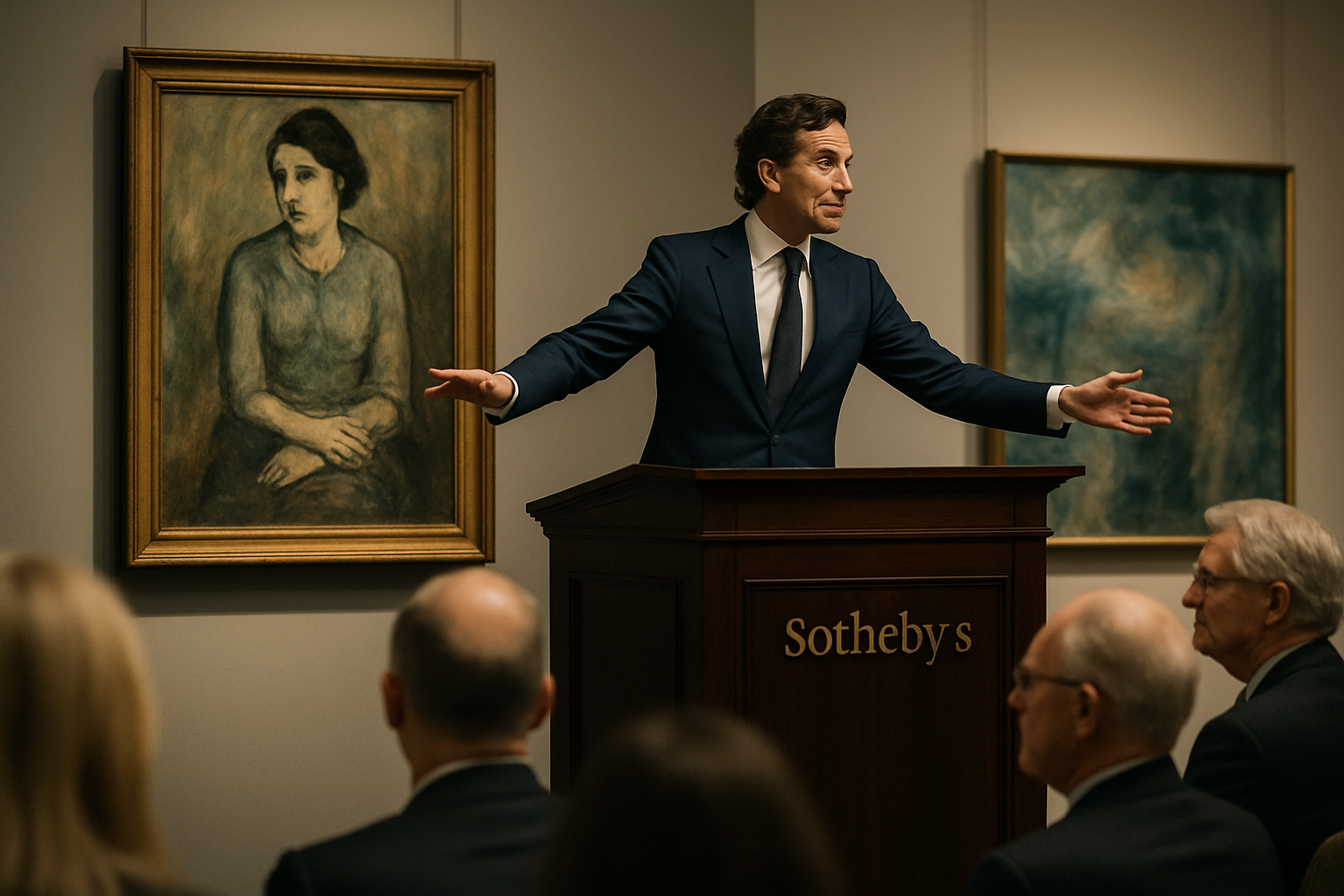
Wednesday, June 24 was reportedly London's hottest day on record this year — and the temperature inside Sotheby's New Bond Street salesroom matched it. In a single extraordinary evening, the auction house staged what now stands as the most valuable single-owner collection sale in European history, extracting £296.3 million ($392.6 million) from 25 works amassed over five decades by British billionaire Joe Lewis and his daughter Vivienne. The result nearly doubled the pre-sale estimate of approximately $200 million. When a follow-on modern and contemporary evening sale was added to the tally, Sotheby's closed the night with a total of £393.4 million ($520.7 million) — the largest haul ever achieved at auction in a single European session, according to the house.
For collectors trying to read the market in mid-2026, this sale is essential reading. The data it produced goes beyond celebrity provenance and headline numbers; it maps, with unusual clarity, exactly which categories of work command uncapped demand, where Asian capital is flowing, and why London — despite years of post-Brexit anxiety — can still stage a genuinely global auction event.
The Lots That Defined the Evening
The collection's architecture was built around European Modernism and post-war British figuration — a pairing that proved strategically astute. Assembled over almost half a century by Lewis and his daughter Vivienne, the collection offered a stellar survey of European Modernism and post-war figuration, spanning artists from Gustav Klimt, Egon Schiele and Amedeo Modigliani to Pablo Picasso and Lucian Freud. Many of the key works had been quietly held for decades, contributing an atmosphere of genuine discovery to the proceedings.
The top lot was Amedeo Modigliani's Nu assis au collier (1917–18), a female nude that carries the kind of scandalous institutional backstory that galvanizes bidding rooms. Lewis bought it in 1995 for $12.4 million; last night it sold on a single bid for £41.5 million (£48.2 million with fees) to Sotheby's senior specialist in Europe and Asia, Simon Stock, having been priced "in excess" of £45 million. That is a return that makes most alternative asset classes look timid.
Second place went to Gustav Klimt's Bildnis Gertrud Loew (Gertha Felsőványi) of 1902. The portrait depicts a member of a prominent Viennese Jewish family who fled Austria following the Nazi annexation in 1938. Its history — including a period on display at New York's Neue Galerie and a subsequent restitution dispute — lent it both art-historical weight and fresh-to-market rarity. It was snapped up by the canny collector in 2013, when it resurfaced on the market following a dispute between the Klimt Foundation and Felsőványi's descendants. On June 24, it sold for £36.2 million ($47.9 million) — well above its £20 to £30 million estimate — to an Asian private collector.
Third on the podium was Lucian Freud's Sleeping by the Lion Carpet (1995–96), the monumental nude portrait of his muse Sue Tilley. Another hotly anticipated lot, Lucian Freud's Sleeping by the Lion Carpet (1995–96) — described by the critic Martin Gayford as "the best painting Freud ever painted" — sold at its £25 million low estimate, or £29.3 million with fees. The work sold cleanly if not spectacularly, confirming sustained institutional-grade demand for late Freud without inspiring a bidding war.
Surprises and Outliers
If the Modigliani and the Klimt were expected to lead, the evening's most striking data point may have been René Magritte's La Belle Promenade. The surprise success of the night was surely René Magritte's La Belle Promenade, which had not been exhibited in nearly 60 years. A rush of bidding shot the work past its high estimate of £4 million ($5.2 million), and there was palpable excitement in the room as it sold to an in-person bidder for £16 million ($21.2 million). That is approximately four times the high estimate — the kind of result that rewards consignors who bring genuinely fresh material to market.
Gustave Caillebotte's Portrait de Paul Hugot (1878) was another outlier. Portrait de Paul Hugot (1878) sold for £10.3 million ($13.6 million) after ten minutes of bidding, easily doubling its £4.5 million high estimate. Works by Caillebotte appear rarely at auction, and collector interest that has been building around the French Impressionist — fuelled partly by a major Musée d'Orsay retrospective — found a clear commercial expression here.
Not every lot outperformed. Egon Schiele's Danaë (1909) sold for £17.9 million ($23.6 million), just shy of its £18 million top estimate. That figure is telling context: when Sotheby's New York had attempted to offer the same work in a 2017 Impressionist and modern sale, it carried an estimate of $30 million to $40 million and was withdrawn. Wednesday's price, while strong, reflects a recalibration of where Schiele currently sits in the market. A single Edgar Degas, estimated at £3 to £4 million, was the one lot that failed to sell — the evening's only blemish.
The Asian Buyer Factor
Perhaps the most consequential structural observation from the evening concerns buyer geography. The sale also underscored the continuing importance of Asian buyers to the upper-end of the art market. Collectors from the region bid on half of the 25 lots offered and accounted for around a third of the auction's total, according to Sotheby's. Several of the highest-value works, including the Klimt portrait, were secured by bidders channelled through the auction house's Asia chairman Wendy Lin.
"We are seeing the return of people to the salesrooms in London," Clare Keiller, director of research at advisory firm Beaumont Nathan, said in the sale's aftermath. "Asian bidding is back — we also saw that in New York [in May] — and that has made a big difference." That observation aligns precisely with the spring auction season in New York, where Christie's and Sotheby's both reported significant Asian participation in their blockbuster May sales.
For advisors managing collections on behalf of European institutions or private sellers: the data suggests that bringing trophy-grade material to London remains viable, provided the provenance and freshness are in place. Asian capital is no longer exclusively routing through Hong Kong.
London's Brexit Stigma, Briefly Suspended
The result carries significance well beyond the individual lots. London's auction market has been navigating a difficult period since Brexit, with dealers, galleries and auction houses all reporting disruptions to the movement of art, changes in buyer behaviour and a perception in some quarters that the city has lost ground to Paris as a centre for selling work at the highest level of the market.
The total nearly tripled the previous British record of £101 million, set by the collection of Pauline Karpidas last September, and provided a particularly bright spot for a London market that has struggled to shake off concerns over Brexit, taxation and competition from New York, Hong Kong and even Paris. The Lewis sale also surpassed the previous European single-owner benchmark — the Yves Saint Laurent and Pierre Bergé collection, which realised €373.9 million in Paris in 2009.
For context, the combined night's total was more than five times the $85.7 million total at Sotheby's London sales last June — and it also beat the house's last pre-Brexit June evening sale, which brought in $280.1 million in 2015. That is a benchmark collectors and advisors should hold in mind: London has, in a single evening, erased its post-referendum discount at the very top end of the market.
It is worth noting that the collection came without any pre-sale guarantees — a structural choice that Clare Keiller described as instrumental, noting that the lack of guarantees and "reasonable" estimates spurred generous bidding, improving the optics. In a market where guarantee-laden sales have sometimes produced underwhelming room energy, the Lewis evening demonstrated that the right material, consigned with confidence and at credible estimates, can generate its own momentum.
What Collectors Should Take Away
The Lewis sale crystallises several principles that are shaping the 2026 market. First: scarcity and freshness remain the most reliable price accelerants. The Magritte, unseen publicly for nearly six decades, tripled expectations. The Caillebotte, rarely offered at auction at any level, more than doubled. These outliers were not accidents — they were the logical result of presenting material for which no secondary-market price anchor existed.
Second: the collection's sale reflects current demand, in that it was top notch and built on historically important works with strong provenance. In the current environment, buyers are deliberate. They are rewarding quality and established art-historical significance while remaining selective on mid-tier material. "With the market having had a few setbacks over the past few years, there has been a flight to quality and more blue-chip tastes," Keiller observed — a sentiment now backed by nine figures of evidence.
Third: the Great Wealth Transfer is not moving contemporary art as smoothly as many predicted. The results seem to disprove the narrative that a younger generation of collectors are not interested in the post-war and Impressionist art purchased by their predecessors. Klimt, Modigliani, and Freud remain potent draws for new capital, including capital originating in Asia.
For collectors positioning now: the Lewis sale provides a cleaner real-time read on the market than any report or survey. Works with provenance depth, genuine freshness, and a legible place in art history are finding audiences prepared to pay well above estimate. The K-shaped market — strong at the trophy level, cautious in the middle — is real. But the trophy ceiling, as this evening demonstrated, has not closed.