
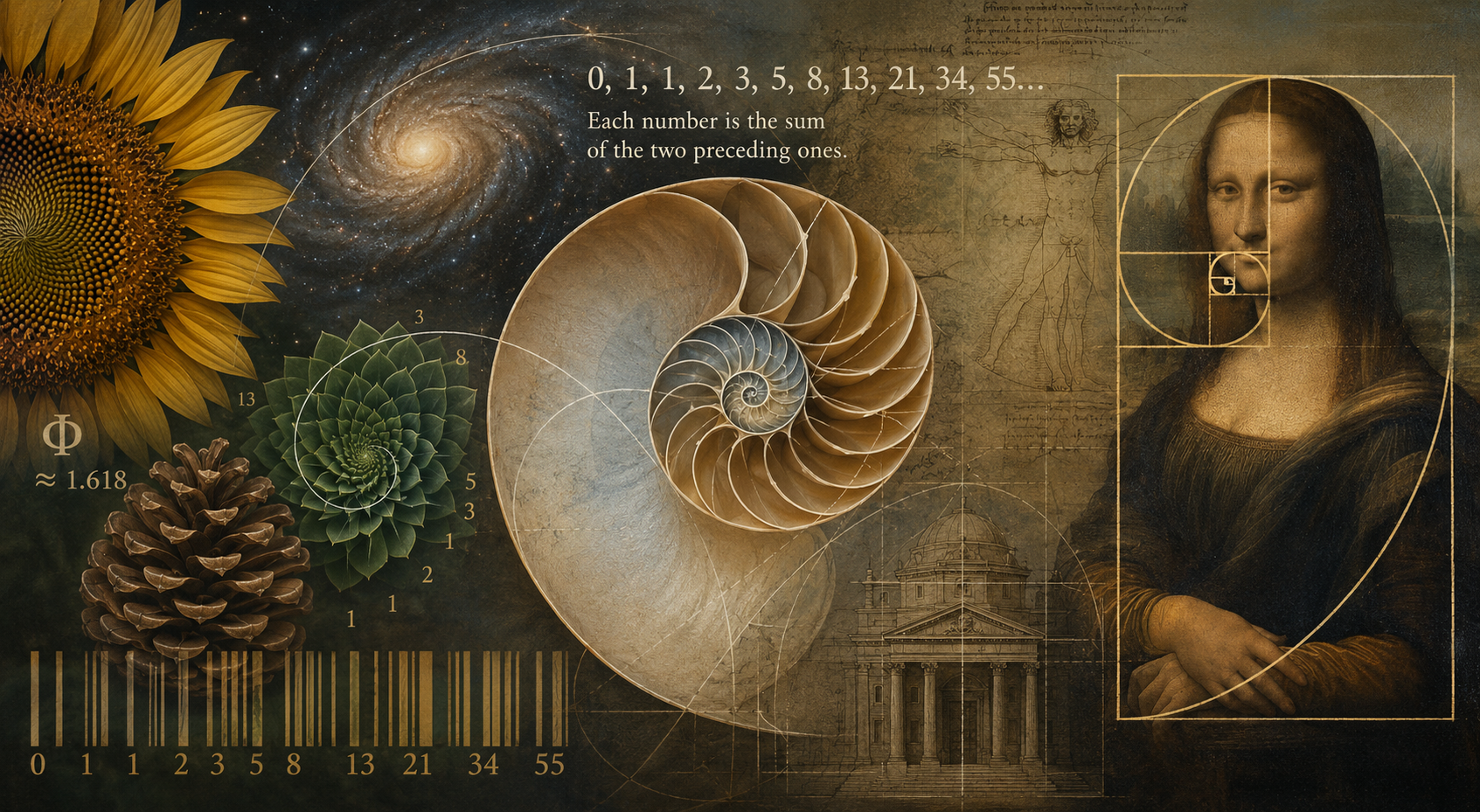
Is there something that connects art, nature, and even the invisible? While there are many possible answers—and many more that remain unknown—the Fibonacci sequence is a pattern that seems to link these seemingly distant realms. This intriguing numerical sequence appears throughout nature and has also informed the composition of some of the Western world's greatest masterpieces. Beyond neuroscientific studies suggesting that the human brain is naturally drawn to patterns, there seems to be something universally comforting about finding order amid the chaos of everyday life. This sense of harmony is reflected in both art and nature, perhaps helping explain why art has the power to transform us, if only we take the time to contemplate.
What is the Fibonacci sequence?
The Fibonacci sequence is the numerical series 0, 1, 1, 2, 3, 5, 8, 13, 21, 34, and 55, in which each number is the sum of the two preceding ones. Although this may seem like a mathematical exercise, the sequence appears throughout the natural world, from the spirals of galaxies to the arrangement of sunflower seeds, pinecones, and leaves around a stem. More recent studies have also identified Fibonacci-related patterns within the human body, from body proportions to molecular and cellular structures. It is also present in everyday objects, from architecture to product design.
Its name comes from a key figure in the development of Western mathematics. The 13th-century Italian mathematician and merchant Leonardo of Pisa, better known as Fibonacci, most likely learned about this sequence while traveling in North Africa with his father, a customs official for the Republic of Pisa. Through his influential book Liber Abaci (Book of Calculation), published in 1202, he introduced Hindu-Arabic numerals and arithmetic methods to medieval Europe after studying mathematical traditions from North Africa and the Middle East. Although the sequence had already been described in India around the 6th century, Fibonacci's work, the first European textbook on mathematics, spread these ideas throughout the Western world.
It was not until the 19th century, after French mathematician Édouard Lucas officially named the sequence after Fibonacci, that scientists began to notice how often it appeared in nature. The spirals of sunflower seeds, the arrangement of leaves around a stem, and even the genealogy of male honeybees all follow Fibonacci patterns. Rather than being consciously "designed," these configurations often emerge because they are highly efficient ways for living organisms to grow, organize, and maximize space.
The Golden Ratio and Fibonacci
The Fibonacci sequence is linked with the Golden Ratio (approximately 1.618), also known as the Golden Section, the divine proportion, or the Greek letter phi (Φ). An easier way to visualize the Golden Ratio—at least for non-mathematical minds like mine—is the Golden Spiral, which expands by a factor of about 1.618 with each quarter turn. When learning about artistic composition, many of us were taught to draw a spiral over famous paintings to explain why certain compositions draw our gaze. Often, the spiral naturally guides the viewer's eye toward the artwork's focal point or the section that captures our attention.
As a BBC podcast episode notes, the Golden Ratio has been studied since the time of the ancient Greeks. Euclid (c. 300 BC) discussed it before the Fibonacci sequence was studied in detail, and the two concepts evolved separately, which makes this far more intriguing. While there is no consensus, the Golden Ratio has often been associated with Phidias (c. 480–430 BC), the Greek sculptor best known for supervising the sculptures of the Parthenon. Where the two concepts converged remains unclear. Yet it took on particular significance during the Renaissance, when artists sought mathematical harmony in their compositions.
In the late 15th century, the Golden Ratio was first called "the divine proportion" in Divina Proportione, a book on geometry and architecture by the Italian mathematician and friar Luca Pacioli, illustrated by Leonardo da Vinci. Leonardo himself became one of its most celebrated practitioners, carefully studying proportion, perspective, and the geometry of the human body, including the human face. The Mona Lisa, for example, is often interpreted as incorporating the Golden Ratio throughout its composition, creating varied focal points where our gaze naturally rests. For Renaissance artists, mathematics was not simply a technical tool but a means of revealing the hidden order of the universe. Other artists, such as Michelangelo and Sandro Botticelli, also appear to have used it.
Reinterpreting the Golden Ratio
As artistic movements evolved, many artists challenged these compositional conventions, embracing abstraction and experimentation. Yet patterns never disappeared from artistic practice. Russian painter Wassily Kandinsky incorporated geometric and mathematical principles into his abstract compositions, linking them to music and spirituality. Likewise, Salvador Dalí explored mathematical forms throughout his later works, and Georges Seurat's highly structured compositions reflected a similarly systematic approach to visual organization.
Contemporary artists often reinterpret these mathematical ideas. One example is In the House of the Hidden Places (2021) by the British artistic duo Shuster + Moseley, presented at the Art D'Égypte exhibition beside the Pyramids of Giza. The installation featured four monumental glass sculptures whose reflective surfaces shifted with the movement of sunlight throughout the day. Drawing on research into the geometry of the Great Pyramid, the work incorporated the Fibonacci sequence, the Golden Ratio, and π, aligning with celestial points and transforming mathematical relationships into an immersive visual experience.
Similarly, Colombian artist Camila Echavarría explores mathematical systems through carefully constructed compositions that blend precise calculation with intuition and a poetic contemplation of nature. This approach suggests that logic and emotion can coexist in the creative process. In Echavarría's paintings, the Fibonacci sequence becomes expressive depictions of trees and tulips (forms that, by themselves, follow this mathematical pattern), interwoven with fragments of barcodes that encode the sequence. The result is compositions that hint at something deeper, perhaps even spiritual.
Not every artwork follows the Golden Ratio, and scholars continue to debate many of these associations because it can at times seem possible to force this ratio into any artwork. In some cases, the relationship may have been intentional; in others, it may have been identified only after the work was completed. Regardless, the Fibonacci sequence and the Golden Ratio have undeniably shaped artistic thinking for centuries and continue to inspire artists today.
Why are we drawn to patterns?
There may be something deeper that draws us toward these patterns. Yet there is no consensus on this matter. In 2009, Adrian Bejan, a professor of mechanical engineering at Duke University in Durham, North Carolina, argued, according to a Guardian article, that our eyes can interpret an image featuring the Golden Ratio faster than any other.
The influential 2023 book Your Brain on Art: How the arts transform us by Ivy Ross and Susan Magsamen offers another perspective, aiming to show how engaging in any form of art can improve our emotional, mental, and physical health. The book explains that "the brain is a meaning-making machine" that constantly seeks to connect information, identify patterns, and build neural pathways from our experiences. Pattern recognition is one of the brain's most fundamental abilities, helping us make sense of everything from language and music to landscapes and works of art.
This does not necessarily mean that every person finds artworks in which the Golden Ratio prevails beautiful, which would be a risky assertion in itself. Our responses to art are also shaped by memory, culture, personal experience, and countless unconscious processes, which may vary from day to day. The authors also note that there is often a discrepancy between what we consciously think and what we biologically feel.
Perhaps this uniqueness and the complexity behind human perception are precisely why art remains so powerful. It is as much a creative expression as it is a lifeline. Rather than providing a scientific explanation for why certain patterns move us, the Fibonacci sequence offers one example—among infinitely many—of how art and nature are connected through structures that often remain invisible to us. It reminds us that beauty can emerge from order, but also that meaning is something we continually create.
Whether found in a flower, a galaxy, or a painting, these patterns invite us to pause, look more closely, and recognize that the boundaries between mathematics, nature, and art may be far more intertwined than they first appear. As I think back to the last painting that truly captured my gaze, I can't help but wonder whether, beyond our conscious recognition of patterns, perception is both biology and art.