
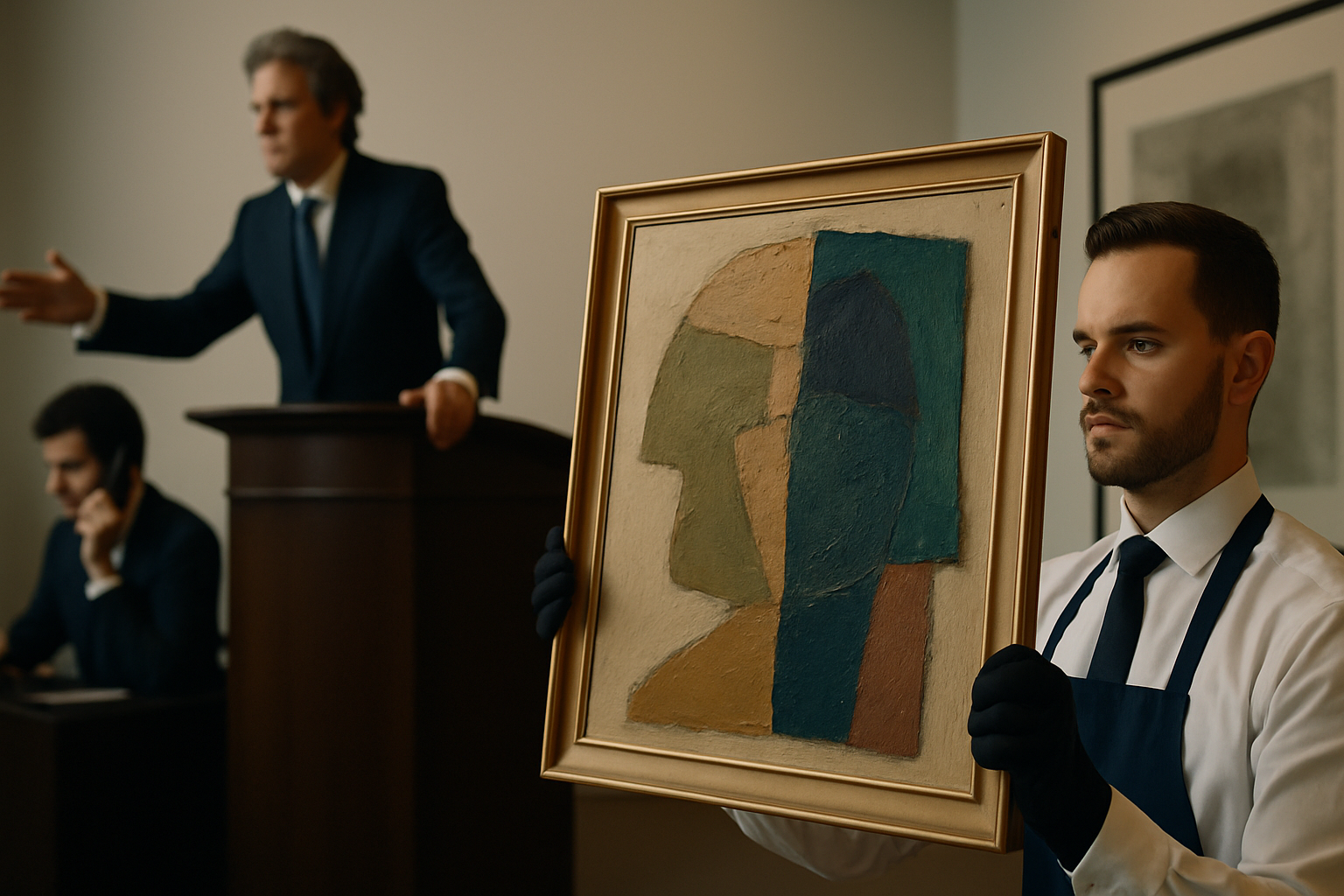
The numbers arrived in quick succession across July, each larger than the last, and together they assembled a picture the art market has not seen in four years. Christie's, Sotheby's, and Phillips combined for $6.77 billion in first-half 2026 auction sales — the strongest opening six months since 2022 and nearly 70 percent higher than the same period in 2025. For an industry that had endured three consecutive years of declining sales, the mood at the major houses is something they had not permitted themselves in some time: genuine optimism. But the figures reward close reading. Strip away the blockbuster estate sales and trophy lots that anchored the May and June marquee evenings, and a more complicated landscape emerges — one that should sharpen, not relax, every collector's strategic thinking for the remainder of the year.
The Numbers, Properly Contextualized
Christie's reported total revenue of $4.5 billion for the first six months of 2026, with public auction sales reaching $3.5 billion — up 71 percent on the same period in 2025 — and a sell-through rate by lot of 91 percent, against 87 percent the prior year. Private sales contributed just over $1 billion. Sotheby's figures were closely comparable: public auction sales of $3.4 billion, up 59 percent year-on-year, with a 90 percent sell-through rate and private sales of $826 million, a record for the house and an all-time high in overall turnover of $4.4 billion. Phillips, meanwhile, posted a 60 percent increase in first-half sales to $507 million. Heritage Auctions, which specialises in collectibles and memorabilia, recorded its best first half in company history at $1.41 billion — nearly 47 percent above its 2025 figure.
These are not modest improvements. They represent, collectively, the sharpest single-season rebound the major houses have posted since the post-pandemic frenzy of 2021–22. Yet analysts and advisers who have examined the underlying data consistently arrive at the same qualification: the recovery is real, but it is narrower than the top-line figures suggest.
Estates Are Doing the Heavy Lifting
The proximate cause of the surge is not difficult to identify. As ARTnews documented this week, the list of collectors whose art has arrived at auction over the past two years reads like the society pages of decades past: Paul Allen, S.I. Newhouse, Robert Mnuchin, Marian Goodman, Leonard Lauder, Barbara Gladstone. Some died; others reached an age at which keeping several hundred million dollars' worth of paintings no longer seemed quite as important as it once did. This generation of collectors has become critical to the market's recovery — at least the one experienced by the major auction houses.
The individual collection results were staggering. Christie's was anchored by the S.I. Newhouse collection, which totalled $630.8 million in New York in May. The top lots from that sale alone — Jackson Pollock's Number 7A (1948) at $181.2 million and Constantin Brancusi's Danaïde at $107.6 million — set the tone for the season. Sotheby's leaned on the Robert Mnuchin Collection, the Lewis Collection (the most expensive single-owner collection ever auctioned in Europe at $392.6 million), and other major estates. Phillips benefited from the collections of Ambassador John L. Loeb Jr. and Tina Hills, alongside a record-breaking watch business.
The structural significance of single-owner collections has accelerated markedly. According to Bank of America and ArtTactic's inaugural U.S. Art Market Report, single-owner sales accounted for an average of just 7 percent of New York's auction value between 2015 and 2020, versus 38 percent in 2025. Almost a third of the combined H1 2026 total came from single-owner collections. As adviser Meredith Darrow put it plainly: "It's just the estates." She argued that the softness of the auction market between 2023 and 2025 owed less to disappearing demand than to a shortage of major collections coming to market — without fresh property, there was simply less for the houses to sell.
Confidence Is Trickling Down — But Unevenly
The ArtTactic mid-year report described the current landscape as a "K-shaped" recovery, where demand remains concentrated at the very top while the middle of the market continues to lag. That framing is accurate, but the more recent data suggests the gap may be beginning to narrow.
"While marquee evening sales have been driven by $5m-plus artworks from major single-owner collections, the strength of day sales demonstrates that confidence has also returned to the market's middle core," Anders Petterson, founder and chief executive of ArtTactic, told The Art Newspaper. He pointed to record sell-through rates in day sales, strong growth in the $50,000 to $500,000 segment, record online auction volumes, and higher numbers of lots sold as evidence that the recovery is broadening, driven by both quality and volume.
The participation data reinforces this narrative. Christie's emphasised record bidder participation and competitive bidding on works estimated between $20,000 and $100,000. Sotheby's highlighted its highest sell-through rate in more than a decade and a record 4.9 bidders per lot. Both figures point to something qualitatively different from the estate-driven trophy market: genuine demand from a widening pool of buyers, even at price points well below the evening-sale threshold.
Notably, pent-up supply is part of the explanation. Collectors reluctant to sell into a bearish market from 2023 through the first half of 2025 began consigning again after the success of the Pauline Karpidas, Cindy and Jay Pritzker, and Leonard Lauder collections in the second half of 2025 demonstrated that the market could absorb quality material at strong prices.
Where the Recovery Hasn't Reached
Phillips's results offer the clearest window onto the market's fault lines. Known for platforming young contemporary artists — a segment that has not yet bounced back — the house's 60 percent year-on-year gain was driven largely by its watch division and the strength of a few major collections, not by a broad resurgence in demand for emerging or ultra-contemporary work.
Small- to mid-tier galleries, specifically those offering emerging art, remain vulnerable — a trend underscored by a number of high-profile gallery closures in 2025. The structural pressures are unchanged: rent, art fair costs, staffing, insurance, and shipping expenses continue to compress margins, even as the secondary market strengthens around them. The guarantee structure, meanwhile, has entrenched itself as the cost of doing business at the top. By 2025, guarantees backed 78 percent of the value of New York Evening Sales, up from 36 percent in 2016 — a sign of consignor caution that the current bullish moment has not yet unwound.
The Art Basel and UBS Global Art Market Report 2026 framed the broader context precisely: "The market welcomed a shift in direction in 2025, from the contraction of previous years to modest growth," said Dr. Clare McAndrew of Arts Economics. But it "continued to operate in a volatile geopolitical environment, particularly regarding cross-border trade, the full implications of which are still unfolding in 2026. While some categories of art were relatively insulated from the direct effects of tariffs, broader policy uncertainty and trade fragmentation created challenges for businesses, affecting pricing and supply."
What This Means for Collectors
The estate rush clarifies several things that the headline numbers obscure, and each has direct implications for how a collector should position themselves in the second half of 2026.
- Provenance is now a pricing variable, not a footnote. In a market structured around the allure of great collections, a work's pedigree — which walls it has hung on, which eye selected it — commands a premium that is structurally new. Buyers competing for Newhouse or Mnuchin material are not simply buying the art; they are buying institutional validation and auction narrative. Collectors building for long-term value should prioritise acquisition from recognised collections whenever the opportunity arises.
- Day sales and the $50K–$500K range represent the market's best value window right now. Sell-through rates in this segment are rising and bidder competition is intensifying, but estimates have not yet adjusted to reflect renewed buyer confidence. This is the corridor where disciplined collectors can still find mispriced quality.
- Emerging and ultra-contemporary remain under pressure — but selectively. The segment has not recovered, but differentiated buyers with long time horizons and gallery relationships have a window to acquire at below-peak prices. The caveat is gallery health: work with dealers whose balance sheets you understand.
- Private sales are growing in strategic importance. Sotheby's recorded a house-record $826 million in private sales in H1 2026; Christie's contributed another $1 billion. For sellers of significant works, private placement now offers price certainty and discretion that the guarantee-heavy evening sale cannot match. Collectors holding strong material should be in active dialogue with specialist departments, not waiting for the autumn catalogue.
- Supply from ageing collectors will not be unlimited. The estate wave currently buoying the major houses reflects a specific generational cohort — the collectors who built during the 1970s through the 1990s — and that supply will eventually exhaust itself. The houses are well aware of this. Collectors who understand that the current moment is partly supply-driven, not purely demand-driven, will resist the temptation to read the moment as the start of a sustained bull cycle.
The art market in mid-2026 is not recovering uniformly. It is recovering at the top, beginning to filter into the mid-market, and still largely stagnant at the emerging end. The estate rush that produced Pollock's $181.2 million result and Brancusi's $107.6 million result created genuine momentum and genuine confidence — but those are not the same thing as a broad, sustainable market expansion. The collector who understands exactly which layer is moving, and why, is the one positioned to act with clarity rather than react to headlines.