Biography
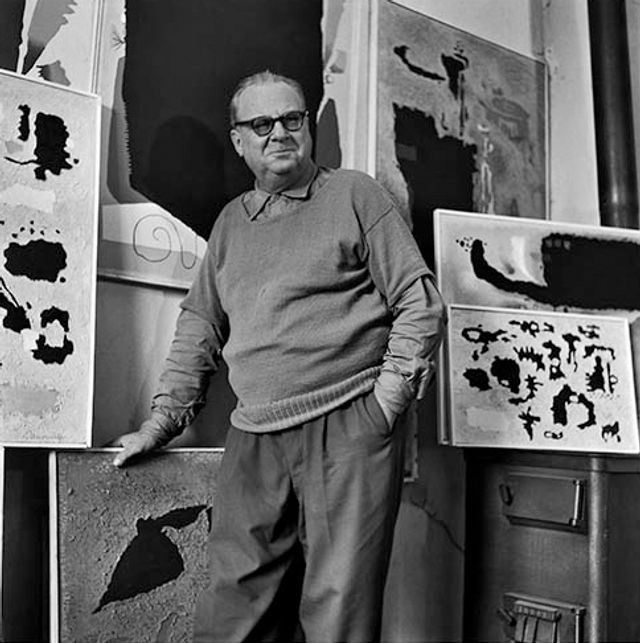
Willi Baumeister was one of the main advocates of abstraction in Germany from the 1920s to his death in 1955. He was in contact with the various art movements that emerged in interwar Europe, but avoided joining any particular group. Baumeister trained as a painter and decorator and in 1909 enrolled at the Kunstakademie in Stuttgart, where he studied under Adolf Hölzel and befriended Otto Meyer-Amden and Oskar Schlemmer; in 1914 he and Schlemmer painted a mural for the Werkbund exhibition in Cologne. He paid his first trip to Paris in 1911 and a year later held his first exhibition at the Galerie Neupert in Zurich. His incipient career was interrupted by the outbreak of the First World War, during which he fought in the Balkans and the Caucasus. On returning to Stuttgart in 1919, he joined the Üecht group. He started on his Wall-paintings, which come close to the work of Fernand Léger, with whom he shared an exhibition at the Der Sturm gallery in Berlin in 1922, and to the ideas of the L’Esprit Nouveau magazine directed by Le Corbusier and Ozenfant. Baumeister gradually became known in the German art world and by the end of the 1920s he enjoyed something of a reputation in France, where his first solo exhibition was held in 1927. Around 1930 organic forms began to take over from geometric shapes. The Sports Pictures were followed by the Ideograms of the end of the decade, in a process that brought him increasingly closer to primitive and prehistoric art. When the Nazis arrived in power in 1933 he was dismissed from his post at the Städelsche Kunstschule in Frankfurt, where he had taught since 1928. His works were included in the exhibition of Entartete Kunst (Degenerate Art) in 1937 and in 1941 he was banned from exhibiting his work. In view of these new circumstances, Baumeister, who decided to remain in Germany, continued to paint secretly and, like Schlemmer, worked at Kurt Herberts paint factory in Wuppertal, where he studied prehistoric painting techniques. The fruit of this research was his treatise Das Unbekannte in der Kunst (The Unknown in Art), published in 1947. When the Second World War ended he was reinstated as one of the greatest living masters of modern German painting and in 1946 he was appointed a professor of the Kunstakademie in Stuttgart.
Track Willi Baumeister
Get notifications when works come to auction, and access market analytics
Create Free AccountAlready have an account? Sign In
Professional documentation gives you clarity, portability, and confidence in your collection.
Learn why collectors document their holdings online


Your collection, accessible anywhere
Access your collection from any device with our cloud-based platform. Native mobile apps provide seamless synchronization and offline browsing, ensuring your collection data is always at hand.


Biography
Willi Baumeister was one of the main advocates of abstraction in Germany from the 1920s to his death in 1955. He was in contact with the various art movements that emerged in interwar Europe, but avoided joining any particular group. Baumeister trained as a painter and decorator and in 1909 enrolled at the Kunstakademie in Stuttgart, where he studied under Adolf Hölzel and befriended Otto Meyer-Amden and Oskar Schlemmer; in 1914 he and Schlemmer painted a mural for the Werkbund exhibition in Cologne. He paid his first trip to Paris in 1911 and a year later held his first exhibition at the Galerie Neupert in Zurich. His incipient career was interrupted by the outbreak of the First World War, during which he fought in the Balkans and the Caucasus. On returning to Stuttgart in 1919, he joined the Üecht group. He started on his Wall-paintings, which come close to the work of Fernand Léger, with whom he shared an exhibition at the Der Sturm gallery in Berlin in 1922, and to the ideas of the L’Esprit Nouveau magazine directed by Le Corbusier and Ozenfant. Baumeister gradually became known in the German art world and by the end of the 1920s he enjoyed something of a reputation in France, where his first solo exhibition was held in 1927. Around 1930 organic forms began to take over from geometric shapes. The Sports Pictures were followed by the Ideograms of the end of the decade, in a process that brought him increasingly closer to primitive and prehistoric art. When the Nazis arrived in power in 1933 he was dismissed from his post at the Städelsche Kunstschule in Frankfurt, where he had taught since 1928. His works were included in the exhibition of Entartete Kunst (Degenerate Art) in 1937 and in 1941 he was banned from exhibiting his work. In view of these new circumstances, Baumeister, who decided to remain in Germany, continued to paint secretly and, like Schlemmer, worked at Kurt Herberts paint factory in Wuppertal, where he studied prehistoric painting techniques. The fruit of this research was his treatise Das Unbekannte in der Kunst (The Unknown in Art), published in 1947. When the Second World War ended he was reinstated as one of the greatest living masters of modern German painting and in 1946 he was appointed a professor of the Kunstakademie in Stuttgart.
Track Willi Baumeister
Get notifications when works come to auction, and access market analytics
Create Free AccountAlready have an account? Sign In
Professional documentation gives you clarity, portability, and confidence in your collection.
Learn why collectors document their holdings onlineYour collection, accessible anywhere
Access your collection from any device with our cloud-based platform. Native mobile apps provide seamless synchronization and offline browsing, ensuring your collection data is always at hand.