Biography
Shusaku Arakawa (1936-2010), produced work in a wide array of media, much of it in association with his wife, Madeline Gins, and guided by their philosophy of Reversible Destiny, which sought to forestall mortality. Arakawa studied medicine and mathematics at the University of Tokyo and art at Musashino College of Art, Tokyo. He exhibited his early work, which took inspiration from the Dadaist movement, in Japan before moving in 1961 to New York City. From 1963 to 1971, Arakawa and Gins collaborated on a project titled The Mechanism of Meaning, a series of more than 80 large canvases that explored the nature of representation through mixed-media collage. Thereafter they worked on art ranging from poetry to film, though they captured the most attention for their unconventional and challenging architectural designs. Among these were the Site of Reversible Destiny (1995), a whimsically landscaped park in Gifu, Japan, and the Bioscleave House (2008), a residence in East Hampton, N.Y., with a deliberately perplexing uneven floor plan. The artists’ City of Reversible Destiny, a planned 30-ha (75-ac) housing project in Tokyo, was never realized, but several apartments were built in adherence to its principles.
Track Shusaku Arakawa
Get notifications when works come to auction, and access market analytics
Create Free AccountAlready have an account? Sign In
Professional documentation gives you clarity, portability, and confidence in your collection.
Learn why collectors document their holdings online


Your collection, accessible anywhere
Access your collection from any device with our cloud-based platform. Native mobile apps provide seamless synchronization and offline browsing, ensuring your collection data is always at hand.


Biography
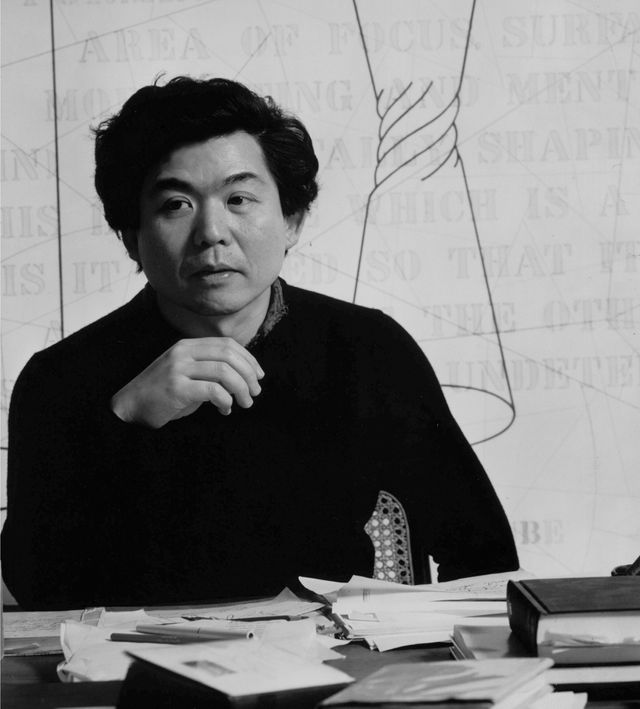
Shusaku Arakawa (1936-2010), produced work in a wide array of media, much of it in association with his wife, Madeline Gins, and guided by their philosophy of Reversible Destiny, which sought to forestall mortality. Arakawa studied medicine and mathematics at the University of Tokyo and art at Musashino College of Art, Tokyo. He exhibited his early work, which took inspiration from the Dadaist movement, in Japan before moving in 1961 to New York City. From 1963 to 1971, Arakawa and Gins collaborated on a project titled The Mechanism of Meaning, a series of more than 80 large canvases that explored the nature of representation through mixed-media collage. Thereafter they worked on art ranging from poetry to film, though they captured the most attention for their unconventional and challenging architectural designs. Among these were the Site of Reversible Destiny (1995), a whimsically landscaped park in Gifu, Japan, and the Bioscleave House (2008), a residence in East Hampton, N.Y., with a deliberately perplexing uneven floor plan. The artists’ City of Reversible Destiny, a planned 30-ha (75-ac) housing project in Tokyo, was never realized, but several apartments were built in adherence to its principles.
Track Shusaku Arakawa
Get notifications when works come to auction, and access market analytics
Create Free AccountAlready have an account? Sign In
Professional documentation gives you clarity, portability, and confidence in your collection.
Learn why collectors document their holdings onlineYour collection, accessible anywhere
Access your collection from any device with our cloud-based platform. Native mobile apps provide seamless synchronization and offline browsing, ensuring your collection data is always at hand.