Biography
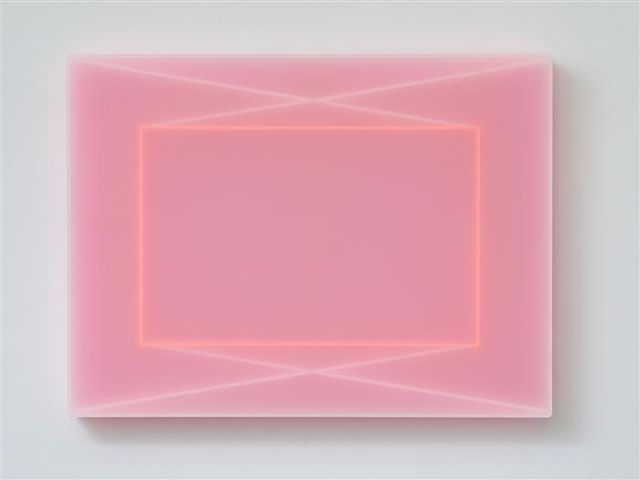
Kāryn Taylor’s recent solo exhibitions speculatively explore the connections between art and the ideas that structure our reality, asking large questions. Such ambitions are promoted by exhibition titles that include Abstract Philosophy, New Geometries and Time. Space. Existence. Her two-dimensional and three-dimensional work falls into a non-objective territory employing space and light as part of the form and effect. Ambient light and the site are also important factors, influencing the changing appearance of reliefs or three-dimensional constructions. In Taylor’s wall-based Perspex box-like objects, shadowy form or coloured line create a luminous exploration of the contained space. Projected geometric shapes in the recent spatial explorations add another layer of complexity to the work. Taylor’s exhibition titles are significant in reflecting how her concerns intersect with the development of scientific knowledge and language. As a practice, her work is dedicated to finding ways to explore some of the greatest abstract ideas through methods that create perceptual and haptic experiences. This is a practice in which testing and investigation comprise a methodology for working through spatial and perceptual experiences bought about by combinations and permutations of forms and materials. This approach, and Taylor’s discussion of its connection to her interest in quantum physics, might suggest her work is part of a pursuit of evidence of how matter and light behave. However, Taylor’s interest is not to mirror the investigations of science at the atomic or subatomic level. Rather than seeking a system or a precise language of matter, Taylor’s work reflects our “unknowing” of how the physical world operates. Taylor’s geometries – whether set in cast acrylic or a composition of rods and projections seemingly delicately balanced on the floor – bring to mind the human predilection to posit theories and design systems of knowledge; and, with this, the fallibility of those systems in resolving questions and contradictions. The artist herself talks of her interest in the “fuzziness” of the current understanding of quantum physics. More broadly the idea of fuzziness could apply to the current status of the project of modernity. The more that we try to replace mysteries and open-endedness with specificities and unified theories, the more distant answers become. Of course Taylor knows this. She is challenging us to be cognizant of our assumptions, for example in regard to metaphysics, as her spatial installations in particular suggest. These works, such as the three structures titled Field Notations (2017), combine milled wooden rods and bent PVC rods, line drawing and projection, connecting across walls and floors like a multi textured net. Occasionally, in a work such as Objective Hypothesis (2017) an additional material such as plywood is added. Unifying an area of floor and wall, these assemblages lightly define space and its boundaries. Yet, the parameters of the volumes are dynamic, constantly shifting with the viewer’s position. Titles such as A Question of Gravity or Balanced Equation in Three Parts convey experimentation with equilibrium. Or, in the case of Holographic Field Event, awareness of how light is not unitary matter but comprised of distinct beams of different phasing and amplitude. The projected moving shapes connect the rods within these works, drawing attention to the range of materials, and adding an additional vocabulary to these installations. These distorting animations project Euclidian forms of triangles and rhomboids, thereby adding a shifting, time-based nature to each spatial construction. Words also create structures. It’s in our nature to keep trying to describe the world. Scientists and philosophers (amongst others) try to capture the world in a net of language. In the 17th century Gottfried Leibniz and John Wilkins searched for a perfect language that would be as logical as mathematics or code. Their ideal language would not only reflect what we know but also shape and guide our knowledge. The Enlightenment search for universals has a long shadow. The logical positivists are amongst those in the 20th century who continued the search for methods to generate objective meaning. Euclidian axioms also aimed to be the basis for true statements about the world. In his first writings, Elements, Euclid postulated five axioms for plane geometry, a type of symbolic language to describe the world. These ranged from the ability of a straight line to span any two points to the parallel postulate. The Elements also included five constructive notions that Taylor’s spatial structures can easily create a challenge to, that: things that are equal to the same thing are equal to one another; if equals are added to equals then the wholes are equal; if equals are subtracted from equals then the remainders are equal; things that coincide with one another are equal to one another; and the whole is greater than the part. Seeing the infinitely various appearance of Taylor’s works forms the basis for proposing that even the information we receive based on experience is relative and provisional. It is the nature of nets to capture some things and leave others open. Taylor’s works counterpoint objective hypotheses with our ways of talking and thinking about what exists based on experience. Since modernity even the idea of beauty is a much-debated concept. Taylor’s work highlights the unsaid and unsolved; by experiencing situations which resist the unified and logical, we may find new languages for looking at, talking and thinking about the world.
Track Karyn Taylor
Get notifications when works come to auction, and access market analytics
Create Free AccountAlready have an account? Sign In
Professional documentation gives you clarity, portability, and confidence in your collection.
Learn why collectors document their holdings online


Your collection, accessible anywhere
Access your collection from any device with our cloud-based platform. Native mobile apps provide seamless synchronization and offline browsing, ensuring your collection data is always at hand.


Biography
Kāryn Taylor’s recent solo exhibitions speculatively explore the connections between art and the ideas that structure our reality, asking large questions. Such ambitions are promoted by exhibition titles that include Abstract Philosophy, New Geometries and Time. Space. Existence. Her two-dimensional and three-dimensional work falls into a non-objective territory employing space and light as part of the form and effect. Ambient light and the site are also important factors, influencing the changing appearance of reliefs or three-dimensional constructions. In Taylor’s wall-based Perspex box-like objects, shadowy form or coloured line create a luminous exploration of the contained space. Projected geometric shapes in the recent spatial explorations add another layer of complexity to the work. Taylor’s exhibition titles are significant in reflecting how her concerns intersect with the development of scientific knowledge and language. As a practice, her work is dedicated to finding ways to explore some of the greatest abstract ideas through methods that create perceptual and haptic experiences. This is a practice in which testing and investigation comprise a methodology for working through spatial and perceptual experiences bought about by combinations and permutations of forms and materials. This approach, and Taylor’s discussion of its connection to her interest in quantum physics, might suggest her work is part of a pursuit of evidence of how matter and light behave. However, Taylor’s interest is not to mirror the investigations of science at the atomic or subatomic level. Rather than seeking a system or a precise language of matter, Taylor’s work reflects our “unknowing” of how the physical world operates. Taylor’s geometries – whether set in cast acrylic or a composition of rods and projections seemingly delicately balanced on the floor – bring to mind the human predilection to posit theories and design systems of knowledge; and, with this, the fallibility of those systems in resolving questions and contradictions. The artist herself talks of her interest in the “fuzziness” of the current understanding of quantum physics. More broadly the idea of fuzziness could apply to the current status of the project of modernity. The more that we try to replace mysteries and open-endedness with specificities and unified theories, the more distant answers become. Of course Taylor knows this. She is challenging us to be cognizant of our assumptions, for example in regard to metaphysics, as her spatial installations in particular suggest. These works, such as the three structures titled Field Notations (2017), combine milled wooden rods and bent PVC rods, line drawing and projection, connecting across walls and floors like a multi textured net. Occasionally, in a work such as Objective Hypothesis (2017) an additional material such as plywood is added. Unifying an area of floor and wall, these assemblages lightly define space and its boundaries. Yet, the parameters of the volumes are dynamic, constantly shifting with the viewer’s position. Titles such as A Question of Gravity or Balanced Equation in Three Parts convey experimentation with equilibrium. Or, in the case of Holographic Field Event, awareness of how light is not unitary matter but comprised of distinct beams of different phasing and amplitude. The projected moving shapes connect the rods within these works, drawing attention to the range of materials, and adding an additional vocabulary to these installations. These distorting animations project Euclidian forms of triangles and rhomboids, thereby adding a shifting, time-based nature to each spatial construction. Words also create structures. It’s in our nature to keep trying to describe the world. Scientists and philosophers (amongst others) try to capture the world in a net of language. In the 17th century Gottfried Leibniz and John Wilkins searched for a perfect language that would be as logical as mathematics or code. Their ideal language would not only reflect what we know but also shape and guide our knowledge. The Enlightenment search for universals has a long shadow. The logical positivists are amongst those in the 20th century who continued the search for methods to generate objective meaning. Euclidian axioms also aimed to be the basis for true statements about the world. In his first writings, Elements, Euclid postulated five axioms for plane geometry, a type of symbolic language to describe the world. These ranged from the ability of a straight line to span any two points to the parallel postulate. The Elements also included five constructive notions that Taylor’s spatial structures can easily create a challenge to, that: things that are equal to the same thing are equal to one another; if equals are added to equals then the wholes are equal; if equals are subtracted from equals then the remainders are equal; things that coincide with one another are equal to one another; and the whole is greater than the part. Seeing the infinitely various appearance of Taylor’s works forms the basis for proposing that even the information we receive based on experience is relative and provisional. It is the nature of nets to capture some things and leave others open. Taylor’s works counterpoint objective hypotheses with our ways of talking and thinking about what exists based on experience. Since modernity even the idea of beauty is a much-debated concept. Taylor’s work highlights the unsaid and unsolved; by experiencing situations which resist the unified and logical, we may find new languages for looking at, talking and thinking about the world.
Track Karyn Taylor
Get notifications when works come to auction, and access market analytics
Create Free AccountAlready have an account? Sign In
Professional documentation gives you clarity, portability, and confidence in your collection.
Learn why collectors document their holdings onlineYour collection, accessible anywhere
Access your collection from any device with our cloud-based platform. Native mobile apps provide seamless synchronization and offline browsing, ensuring your collection data is always at hand.