Biography
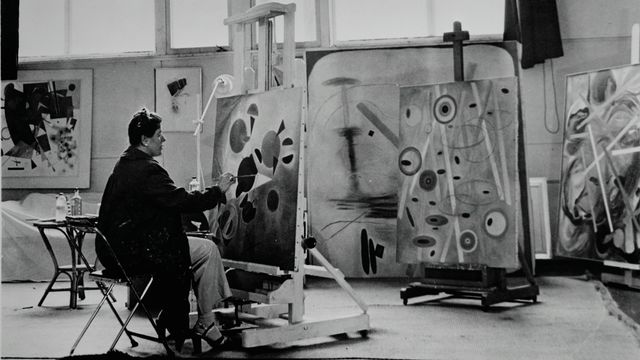
For Hilla Rebay (Baroness Hilla Rebay von Ehrenwiesen, 1890–1967), art, spirituality, and public education on the arts intermingled in an unparalleled career that was instrumental to the creation of the Solomon R. Guggenheim Foundation and Museum. Born into a minor aristocratic family in Alsace, then part of imperial Germany, Rebay was artistically gifted from an early age, particularly as a portrait painter. She was also profoundly interested in spirituality, and from age 14 explored Theosophy, Buddhism, Zoroastrianism, and astrology. In 1908 she began formal artistic studies at Cologne’s Kunstgewerbeschule, moved to Paris a year later and enrolled at the Académie Julian, and the following year, to Munich to study at the progressive Debschitz-Schule. A decade before the Bauhaus, Debschitz did not divide students by gender, and intermingled fine and graphic arts in its curriculum. It had a strong relationship with avant-garde art, counting Ernst Ludwig Kirchner and Sophie Taeuber (later Taeuber-Arp) among its former students and Paul Klee as an instructor for a brief period. Munich in 1910–11 was a hub of creative activity; Rebay’s time there overlapped with the formation of the artist group Der Blaue Reiter (Blue Rider), as well as the studies of fellow artist and collector Katherine S. Dreier and landmark exhibitions at the Moderne Galerie run by the Thannhauser family. In 1912, Rebay returned to Cologne, where she saw a traveling exhibition of Futurist art that was also hugely influential on future Guggenheim collection artists Franz Marc and August Macke, and later participated in her first exhibition. In 1915, with World War I raging, she traveled to Zurich, another hotbed of artistic life due to Switzerland’s neutrality. There she met fellow Alsatian artist Jean Arp, who, with his future wife Taeuber, was a central part of the Dada movement. Despite the fact that she had lived and worked in Munich and Cologne, it was Arp who shared with Rebay The Blue Rider Almanac (Der Blaue Reiter Almanac, 1911), edited by Vasily Kandinsky and Marc, and Kandinsky’s On the Spiritual in Art (Über das Geistige in der Kunst, 1911). Kandinsky’s thoughts on the spiritual nature of abstraction were hugely influential for Rebay and guided both her painting and dedication to nonobjectivity as a collector and museum director. Three decades later, she would translate and publish Kandinsky’s work for the Guggenheim. In 1916, Rebay moved to Berlin, where Arp introduced her to Herwarth Walden, gallerist and publisher of the art and literary magazine Der Sturm. In 1917, she was included in a major group exhibition at Galerie Der Sturm, where she showed a series of sketches, and Composition I (1915), which is now in the Guggenheim collection. It was also at Der Sturm that she met Rudolf Bauer, another abstract painter, who was to become her lover and her chief artistic collaborator for several decades. It was her association with and patronage of Bauer that eventually led Rebay to her other defining partnership, with Solomon Guggenheim. When she immigrated to the United States in 1927 with the goal of establishing a public gallery for nonobjective art, Rebay brought some of Bauer’s work with her. They were hanging on the walls of her studio when Guggenheim sat for a portrait by her around 1928, and he took an interest in the work. The two formed a friendship, and Rebay convinced him to collect some works by Bauer. This was the starting point of a lifelong personal and professional relationship. In 1930, Rebay traveled with Guggenheim and his wife, Irene, to Europe. Among other artists, in Europe they met Kandinsky while he was teaching at the Dessau Bauhaus, and Guggenheim purchased Composition 8 (Komposition 8, 1923), the first of more than 150 works by the artist that would enter the Guggenheim Museum holdings over the years. From this point on, Guggenheim, with Rebay’s input, systematically collected nonobjective art, and the Guggenheims’ suite at the Plaza Hotel in New York was soon decorated with a growing collection of works that was open to the public by appointment by early 1931. For Rebay, abstract art—or nonobjective art, as she referred to that without ties to the natural world—was a higher calling. Her own work in this genre was inventive and dynamic—she was particularly prolific in her work as a collagist, creating works such as Con Brio (1931) and Composition (for a very happy birthday) (1938). She fervently believed that the translation of spiritual impulses and wordless feelings into nonfigurative art was the creation of a visual language that would transcend boundaries for the betterment of humankind. “Non-Objectivity will be the religion of the future,” she wrote in 1937. “Very soon the nations on earth will turn to it in thought and feeling and develop such intuitive powers which lead them to harmony.” She envisioned of a “museum-temple,” where viewers could commune with abstract art. She got her wish in 1937, when the Solomon R. Guggenheim Foundation was created. For the next two decades, she collected and promoted nonobjective painting with a crusading zeal, organizing exhibitions, loans, lectures, and programs for Solomon Guggenheim’s museum, which was formed in 1939. The Museum of Non-Objective Painting opened in 1939 in temporary quarters on East 54th Street, with Rebay as director. Incense filled the air in the new gallery, as did music by Johann Sebastian Bach and Ludwig von Beethoven. Aline Louchheim (later Saarinen), the art critic for the New York Times, later described it as “an esoteric, occult place in which a mystic language was spoken”—a view echoed by many museum visitors, whose reverent comments Rebay published in support of her project. It could not have been more different from the dramatically designed Art of This Century museum/gallery run by Solomon’s niece Peggy Guggenheim, which opened just four blocks away in 1942. By 1943, Rebay and Solomon Guggenheim had commissioned the architect Frank Lloyd Wright to create an innovative design for a permanent museum. His open plan and ramp spiraling toward the light serve as a physical manifestation of the utopian ideals of nonobjectivity. However, Rebay’s formidable character and dedication to metaphysical painting put her at odds with other institutions dedicated to modern art as well as members of Guggenheim’s family. In 1952, after Solomon’s death in 1949, she resigned as director of the foundation and museum, seven years before Wright’s building was completed. Rebay continued to work with the museum in an advisory role, as director emeritus, and painted and collected art in her own right. She spent significant time at her Connecticut home, Franton Court, where she entertained leading lights of the modern art world. After her death in 1967, part of Rebay’s estate—including works by Bauer, Alexander Calder, Albert Gleizes, Kandinsky, Klee, Piet Mondrian, and Kurt Schwitters—joined the Guggenheim’s permanent collection.
Track Hilla Rebay
Get notifications when works come to auction, and access market analytics
Create Free AccountAlready have an account? Sign In
Professional documentation gives you clarity, portability, and confidence in your collection.
Learn why collectors document their holdings online


Your collection, accessible anywhere
Access your collection from any device with our cloud-based platform. Native mobile apps provide seamless synchronization and offline browsing, ensuring your collection data is always at hand.


Biography
For Hilla Rebay (Baroness Hilla Rebay von Ehrenwiesen, 1890–1967), art, spirituality, and public education on the arts intermingled in an unparalleled career that was instrumental to the creation of the Solomon R. Guggenheim Foundation and Museum. Born into a minor aristocratic family in Alsace, then part of imperial Germany, Rebay was artistically gifted from an early age, particularly as a portrait painter. She was also profoundly interested in spirituality, and from age 14 explored Theosophy, Buddhism, Zoroastrianism, and astrology. In 1908 she began formal artistic studies at Cologne’s Kunstgewerbeschule, moved to Paris a year later and enrolled at the Académie Julian, and the following year, to Munich to study at the progressive Debschitz-Schule. A decade before the Bauhaus, Debschitz did not divide students by gender, and intermingled fine and graphic arts in its curriculum. It had a strong relationship with avant-garde art, counting Ernst Ludwig Kirchner and Sophie Taeuber (later Taeuber-Arp) among its former students and Paul Klee as an instructor for a brief period. Munich in 1910–11 was a hub of creative activity; Rebay’s time there overlapped with the formation of the artist group Der Blaue Reiter (Blue Rider), as well as the studies of fellow artist and collector Katherine S. Dreier and landmark exhibitions at the Moderne Galerie run by the Thannhauser family. In 1912, Rebay returned to Cologne, where she saw a traveling exhibition of Futurist art that was also hugely influential on future Guggenheim collection artists Franz Marc and August Macke, and later participated in her first exhibition. In 1915, with World War I raging, she traveled to Zurich, another hotbed of artistic life due to Switzerland’s neutrality. There she met fellow Alsatian artist Jean Arp, who, with his future wife Taeuber, was a central part of the Dada movement. Despite the fact that she had lived and worked in Munich and Cologne, it was Arp who shared with Rebay The Blue Rider Almanac (Der Blaue Reiter Almanac, 1911), edited by Vasily Kandinsky and Marc, and Kandinsky’s On the Spiritual in Art (Über das Geistige in der Kunst, 1911). Kandinsky’s thoughts on the spiritual nature of abstraction were hugely influential for Rebay and guided both her painting and dedication to nonobjectivity as a collector and museum director. Three decades later, she would translate and publish Kandinsky’s work for the Guggenheim. In 1916, Rebay moved to Berlin, where Arp introduced her to Herwarth Walden, gallerist and publisher of the art and literary magazine Der Sturm. In 1917, she was included in a major group exhibition at Galerie Der Sturm, where she showed a series of sketches, and Composition I (1915), which is now in the Guggenheim collection. It was also at Der Sturm that she met Rudolf Bauer, another abstract painter, who was to become her lover and her chief artistic collaborator for several decades. It was her association with and patronage of Bauer that eventually led Rebay to her other defining partnership, with Solomon Guggenheim. When she immigrated to the United States in 1927 with the goal of establishing a public gallery for nonobjective art, Rebay brought some of Bauer’s work with her. They were hanging on the walls of her studio when Guggenheim sat for a portrait by her around 1928, and he took an interest in the work. The two formed a friendship, and Rebay convinced him to collect some works by Bauer. This was the starting point of a lifelong personal and professional relationship. In 1930, Rebay traveled with Guggenheim and his wife, Irene, to Europe. Among other artists, in Europe they met Kandinsky while he was teaching at the Dessau Bauhaus, and Guggenheim purchased Composition 8 (Komposition 8, 1923), the first of more than 150 works by the artist that would enter the Guggenheim Museum holdings over the years. From this point on, Guggenheim, with Rebay’s input, systematically collected nonobjective art, and the Guggenheims’ suite at the Plaza Hotel in New York was soon decorated with a growing collection of works that was open to the public by appointment by early 1931. For Rebay, abstract art—or nonobjective art, as she referred to that without ties to the natural world—was a higher calling. Her own work in this genre was inventive and dynamic—she was particularly prolific in her work as a collagist, creating works such as Con Brio (1931) and Composition (for a very happy birthday) (1938). She fervently believed that the translation of spiritual impulses and wordless feelings into nonfigurative art was the creation of a visual language that would transcend boundaries for the betterment of humankind. “Non-Objectivity will be the religion of the future,” she wrote in 1937. “Very soon the nations on earth will turn to it in thought and feeling and develop such intuitive powers which lead them to harmony.” She envisioned of a “museum-temple,” where viewers could commune with abstract art. She got her wish in 1937, when the Solomon R. Guggenheim Foundation was created. For the next two decades, she collected and promoted nonobjective painting with a crusading zeal, organizing exhibitions, loans, lectures, and programs for Solomon Guggenheim’s museum, which was formed in 1939. The Museum of Non-Objective Painting opened in 1939 in temporary quarters on East 54th Street, with Rebay as director. Incense filled the air in the new gallery, as did music by Johann Sebastian Bach and Ludwig von Beethoven. Aline Louchheim (later Saarinen), the art critic for the New York Times, later described it as “an esoteric, occult place in which a mystic language was spoken”—a view echoed by many museum visitors, whose reverent comments Rebay published in support of her project. It could not have been more different from the dramatically designed Art of This Century museum/gallery run by Solomon’s niece Peggy Guggenheim, which opened just four blocks away in 1942. By 1943, Rebay and Solomon Guggenheim had commissioned the architect Frank Lloyd Wright to create an innovative design for a permanent museum. His open plan and ramp spiraling toward the light serve as a physical manifestation of the utopian ideals of nonobjectivity. However, Rebay’s formidable character and dedication to metaphysical painting put her at odds with other institutions dedicated to modern art as well as members of Guggenheim’s family. In 1952, after Solomon’s death in 1949, she resigned as director of the foundation and museum, seven years before Wright’s building was completed. Rebay continued to work with the museum in an advisory role, as director emeritus, and painted and collected art in her own right. She spent significant time at her Connecticut home, Franton Court, where she entertained leading lights of the modern art world. After her death in 1967, part of Rebay’s estate—including works by Bauer, Alexander Calder, Albert Gleizes, Kandinsky, Klee, Piet Mondrian, and Kurt Schwitters—joined the Guggenheim’s permanent collection.
Track Hilla Rebay
Get notifications when works come to auction, and access market analytics
Create Free AccountAlready have an account? Sign In
Professional documentation gives you clarity, portability, and confidence in your collection.
Learn why collectors document their holdings onlineYour collection, accessible anywhere
Access your collection from any device with our cloud-based platform. Native mobile apps provide seamless synchronization and offline browsing, ensuring your collection data is always at hand.