Biography
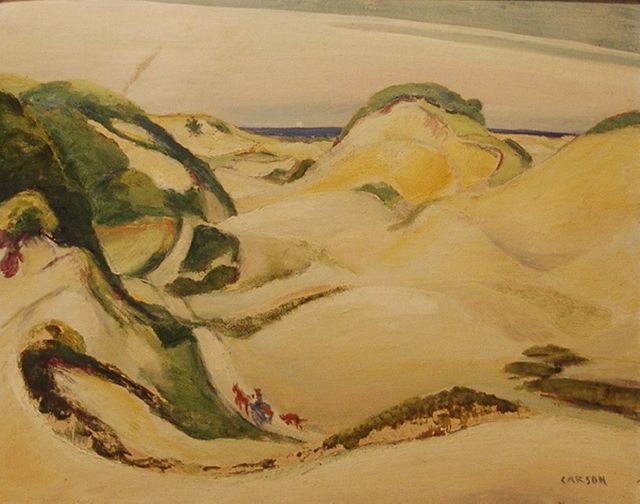
E. Francis (Frank) Carson was born in Waltham, MA, on September 8, 1881. Carson first studied at the Massachusetts School of Art in Boston, then known as the Normal School. He then went on to study with Asa Grant Randall at the Commonwealth Art Colony in Boothbay, Maine, the Fenway Art School in Boston and finally at the Art Students League in New York. His first one-person show was held in New York at the Petrus Stuyvesant Club in 1917. The following year Carson founded the Provincetown Art School where he taught from 1918 until 1933. Carson exhibited annually at the Provincetown Art Association from 1919 to 1934 with the exceptions of 1921, 1927, and 1932. He was a contributing editor of the Lorelei, Journal of Art and Letters published monthly by the artists and writers of Provincetown. That same year he won the first Schneider Prize at the Boston Art Club. Carson also showed with the Boston Society of Independent Artists. It was here that he was exposed to and influenced by a group known as The Four Boston Painters – Maurice Prendergast, Carl Gordon Cutler, Charles Hovey Pepper, and E. Ambrose Webster, who also ran an art school in Provincetown. Carson not only followed Webster’s color theory but followed in his footsteps to Bermuda where he painted and taught while he escaped the harsh New England winter weather. Nancy W. Paine Smith refers to Carson as a “star” among the “hundred present” in her 1927 publication, A Book About the Artists PROVINCETOWN. Carson also had one-person shows at the Copley Society of Boston, the Washington Art Club, and the University of Washington. His pieces have been exhibited at the Pennsylvania Academy of The Fine Arts and the Museum of Fine Arts, Boston. His last address was 483 Tremont Street in Boston where he died on December 29, 1968. A retrospective of his work was held at the Provincetown Art Association and Museum in 1997.
Track Frank Carson
Get notifications when works come to auction, and access market analytics
Create Free AccountAlready have an account? Sign In
Professional documentation gives you clarity, portability, and confidence in your collection.
Learn why collectors document their holdings online


Your collection, accessible anywhere
Access your collection from any device with our cloud-based platform. Native mobile apps provide seamless synchronization and offline browsing, ensuring your collection data is always at hand.


Biography
E. Francis (Frank) Carson was born in Waltham, MA, on September 8, 1881. Carson first studied at the Massachusetts School of Art in Boston, then known as the Normal School. He then went on to study with Asa Grant Randall at the Commonwealth Art Colony in Boothbay, Maine, the Fenway Art School in Boston and finally at the Art Students League in New York. His first one-person show was held in New York at the Petrus Stuyvesant Club in 1917. The following year Carson founded the Provincetown Art School where he taught from 1918 until 1933. Carson exhibited annually at the Provincetown Art Association from 1919 to 1934 with the exceptions of 1921, 1927, and 1932. He was a contributing editor of the Lorelei, Journal of Art and Letters published monthly by the artists and writers of Provincetown. That same year he won the first Schneider Prize at the Boston Art Club. Carson also showed with the Boston Society of Independent Artists. It was here that he was exposed to and influenced by a group known as The Four Boston Painters – Maurice Prendergast, Carl Gordon Cutler, Charles Hovey Pepper, and E. Ambrose Webster, who also ran an art school in Provincetown. Carson not only followed Webster’s color theory but followed in his footsteps to Bermuda where he painted and taught while he escaped the harsh New England winter weather. Nancy W. Paine Smith refers to Carson as a “star” among the “hundred present” in her 1927 publication, A Book About the Artists PROVINCETOWN. Carson also had one-person shows at the Copley Society of Boston, the Washington Art Club, and the University of Washington. His pieces have been exhibited at the Pennsylvania Academy of The Fine Arts and the Museum of Fine Arts, Boston. His last address was 483 Tremont Street in Boston where he died on December 29, 1968. A retrospective of his work was held at the Provincetown Art Association and Museum in 1997.
Track Frank Carson
Get notifications when works come to auction, and access market analytics
Create Free AccountAlready have an account? Sign In
Professional documentation gives you clarity, portability, and confidence in your collection.
Learn why collectors document their holdings onlineYour collection, accessible anywhere
Access your collection from any device with our cloud-based platform. Native mobile apps provide seamless synchronization and offline browsing, ensuring your collection data is always at hand.