Biography
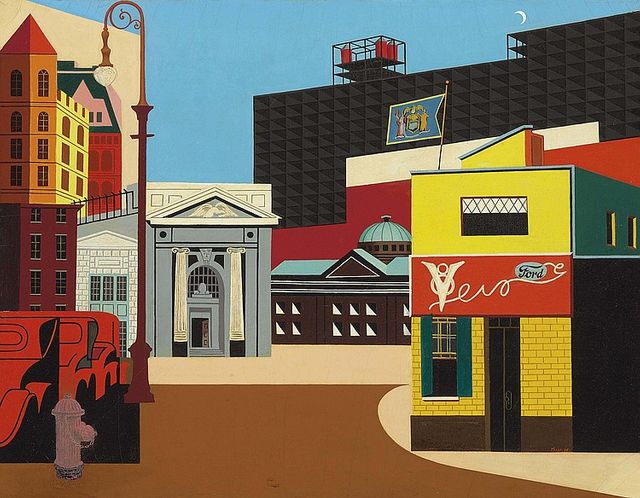
Criss was born in London and immigrated with his family at age four. He attended the Pennsylvania Academy of the Fine Arts from 1917 to 1921 on a scholarship, and later the Art Students League of New York and the Barnes Foundation, and he took private classes with Jan Matulka. In addition to doing work for the U.S. Government under the New Deal, and contributing a mural for the Williamsburg Housing Project in Brooklyn for the Federal Art Project, Criss taught at the leftist American Artists School in the 1930s. His pupils there included Ad Reinhardt. He also held teaching positions at numerous other institutions, including the Albright Museum School, Buffalo; the Art Students League; the New School for Social Research; and the School of Visual Arts. Criss was awarded a Guggenheim Fellowship in 1934. The work from his best-known years, the 1930s and 1940s, is characterized by imagery of the urban environment, such as elevated subway tracks, skyscrapers, streets, and bridges. Criss rendered these subjects with a streamlined, abstracted style, devoid of human figures, that led him to be associated with the Precisionism movement. With distorted perspectives and dream-like juxtapositions, as in Jefferson Market Courthouse (1935), these empty cityscapes also suggest the influence of Surrealism. A turn towards more commercial work later in his career—including a November 1942 cover for Fortune Magazine—led to a decline in his reputation.
Track Francis H. Criss
Get notifications when works come to auction, and access market analytics
Create Free AccountAlready have an account? Sign In
Professional documentation gives you clarity, portability, and confidence in your collection.
Learn why collectors document their holdings online


Your collection, accessible anywhere
Access your collection from any device with our cloud-based platform. Native mobile apps provide seamless synchronization and offline browsing, ensuring your collection data is always at hand.


Biography
Criss was born in London and immigrated with his family at age four. He attended the Pennsylvania Academy of the Fine Arts from 1917 to 1921 on a scholarship, and later the Art Students League of New York and the Barnes Foundation, and he took private classes with Jan Matulka. In addition to doing work for the U.S. Government under the New Deal, and contributing a mural for the Williamsburg Housing Project in Brooklyn for the Federal Art Project, Criss taught at the leftist American Artists School in the 1930s. His pupils there included Ad Reinhardt. He also held teaching positions at numerous other institutions, including the Albright Museum School, Buffalo; the Art Students League; the New School for Social Research; and the School of Visual Arts. Criss was awarded a Guggenheim Fellowship in 1934. The work from his best-known years, the 1930s and 1940s, is characterized by imagery of the urban environment, such as elevated subway tracks, skyscrapers, streets, and bridges. Criss rendered these subjects with a streamlined, abstracted style, devoid of human figures, that led him to be associated with the Precisionism movement. With distorted perspectives and dream-like juxtapositions, as in Jefferson Market Courthouse (1935), these empty cityscapes also suggest the influence of Surrealism. A turn towards more commercial work later in his career—including a November 1942 cover for Fortune Magazine—led to a decline in his reputation.
Track Francis H. Criss
Get notifications when works come to auction, and access market analytics
Create Free AccountAlready have an account? Sign In
Professional documentation gives you clarity, portability, and confidence in your collection.
Learn why collectors document their holdings onlineYour collection, accessible anywhere
Access your collection from any device with our cloud-based platform. Native mobile apps provide seamless synchronization and offline browsing, ensuring your collection data is always at hand.