Biography
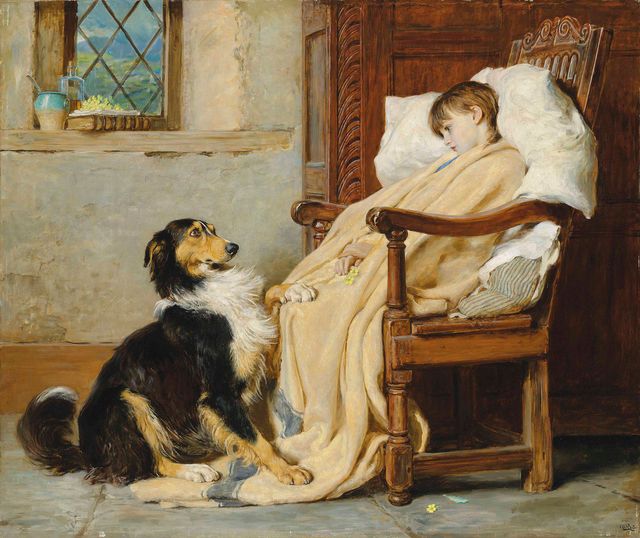
Best known as an animal painter, Rivière was considered the successor to Britain’s great animalier Sir Edwin Landseer. Throughout his career, he painted contemporary genre, classical, and biblical themes, invariably involving animals, which proved extremely popular during the heyday of late Victorian classicism. Aphrodite is a compelling example of Rivière’s work; a scene showing the goddess of love and beauty surrounded by a group of wild animals, seemingly under her spell. Unlike most painters, he did not focus on the subject’s erotic potential, but chose an unusual scene derived from a Homeric hymn (8th-6th centuries BC). A label written by the artist is attached to the reverse of this painting, and contains the specific verse: Born into a family of artists of French descent, Rivière began his artistic training with his father William Rivière, and studied drawing and painting at Oxford University – where his father was a drawing master. His passion for animals began when he was a child, making sketches at the London Zoo, and in his studio, which included a menagerie of domesticated animals – dogs, horses, sheep, and pigs. He began to exhibit regularly at the Royal Academy in 1858, but his first commercial success came in 1871 with Circe and the Friends of Ulysses (private collection), using the pigs he kept at his home as his models. In 1878, Rivière was elected an Associate of the Royal Academy (A.R.A.), and in 1881, a Royal Academician (R.A.).
Track Briton Riviere
Get notifications when works come to auction, and access market analytics
Create Free AccountAlready have an account? Sign In
Professional documentation gives you clarity, portability, and confidence in your collection.
Learn why collectors document their holdings online


Your collection, accessible anywhere
Access your collection from any device with our cloud-based platform. Native mobile apps provide seamless synchronization and offline browsing, ensuring your collection data is always at hand.


Biography
Best known as an animal painter, Rivière was considered the successor to Britain’s great animalier Sir Edwin Landseer. Throughout his career, he painted contemporary genre, classical, and biblical themes, invariably involving animals, which proved extremely popular during the heyday of late Victorian classicism. Aphrodite is a compelling example of Rivière’s work; a scene showing the goddess of love and beauty surrounded by a group of wild animals, seemingly under her spell. Unlike most painters, he did not focus on the subject’s erotic potential, but chose an unusual scene derived from a Homeric hymn (8th-6th centuries BC). A label written by the artist is attached to the reverse of this painting, and contains the specific verse: Born into a family of artists of French descent, Rivière began his artistic training with his father William Rivière, and studied drawing and painting at Oxford University – where his father was a drawing master. His passion for animals began when he was a child, making sketches at the London Zoo, and in his studio, which included a menagerie of domesticated animals – dogs, horses, sheep, and pigs. He began to exhibit regularly at the Royal Academy in 1858, but his first commercial success came in 1871 with Circe and the Friends of Ulysses (private collection), using the pigs he kept at his home as his models. In 1878, Rivière was elected an Associate of the Royal Academy (A.R.A.), and in 1881, a Royal Academician (R.A.).
Track Briton Riviere
Get notifications when works come to auction, and access market analytics
Create Free AccountAlready have an account? Sign In
Professional documentation gives you clarity, portability, and confidence in your collection.
Learn why collectors document their holdings onlineYour collection, accessible anywhere
Access your collection from any device with our cloud-based platform. Native mobile apps provide seamless synchronization and offline browsing, ensuring your collection data is always at hand.