Bouke De Vries
Biography
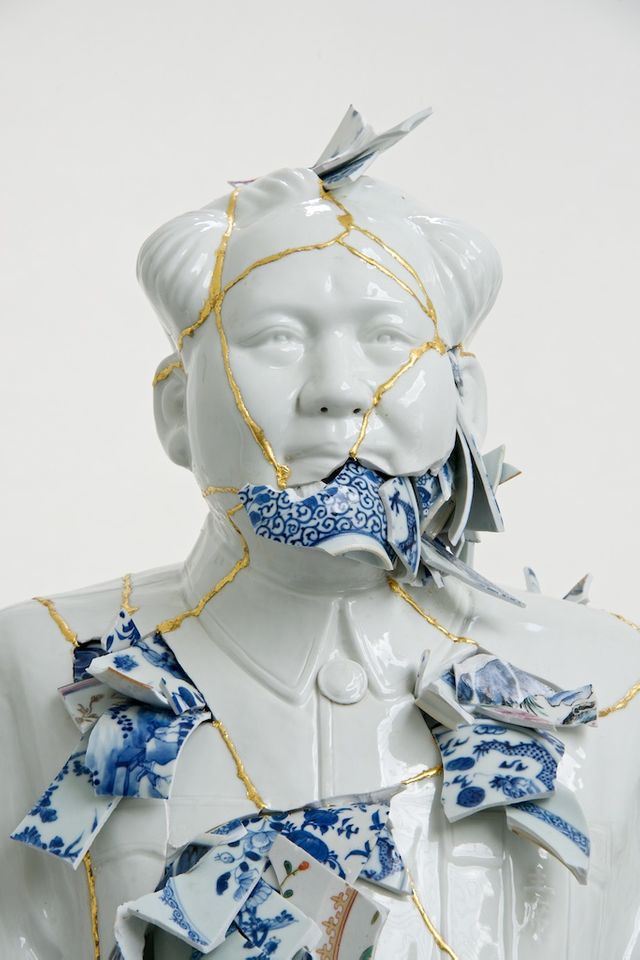
Born Utrecht, The Netherlands - Studied Design Academy, Eindhoven 1978-81 Central School of Art, London 1981-82 - Worked Stephen Jones Millinery, 1981-83 John Galliano, 1983-85 Zandra Rhodes, 1985-89 - Studied West Dean College, 1989-92 - Worked Self-employed ceramics conservator, 1992- Artist, 2009- Born in Utrecht, The Netherlands, Bouke de Vries studied at the Design Academy Eindhoven, and Central St Martin’s, London. After working with John Galliano, Stephen Jones and Zandra Rhodes, he switched careers and studied ceramics conservation and restoration at West Dean College. Every day in his practice as a private conservator he was faced with issues and contradictions around perfection and worth: 'The Venus de Milo' is venerated despite losing her arms, but when a Meissen muse loses a finger she is rendered virtually worthless.’ Using his skills as a restorer (c.f. Ron Mueck’s model-maker skills), his ‘exploded’ artworks reclaim broken pots after their accidental trauma. He has called it ‘the beauty of destruction’. Instead of reconstructing them, he deconstructs them. Instead of hiding the evidence of this most dramatic episode in the life of a ceramic object, he emphasises their new status, instilling new virtues, new values, and moving their stories forward. The more contemplative works echo the 17th- and 18th-century still-life paintings of his Dutch heritage, especially the flower paintings of the Golden Age, a tradition in which his hometown of Utretch was steeped (de Heem, van Alst, van Huysum inter alia), with their implied decay. By incorporating contemporary items a new vocabulary of symbolism evolves. These ‘dead natures’ – natures morts – give everyday household objects, a plate, a milk jug, a teapot, a modern poignancy that refers back to the vanitas and momentomori paintings of that period. An installation in de Vries’s London house is arranged in the manner of Daniel Marot with white Delft domestic pottery rescued in fragments from 17th- and 18th-century rubbish tips, now dug up and partially pieced together. Among them are two small artists’ paint pots with the pigment still in them, as possibly once used by – who knows? – Vermeer or Rembrandt.
Track Bouke De Vries
Get notifications when works come to auction, and access market analytics
Create Free AccountAlready have an account? Sign In
Professional documentation gives you clarity, portability, and confidence in your collection.
Learn why collectors document their holdings online


Your collection, accessible anywhere
Access your collection from any device with our cloud-based platform. Native mobile apps provide seamless synchronization and offline browsing, ensuring your collection data is always at hand.


Bouke De Vries
Biography
Born Utrecht, The Netherlands - Studied Design Academy, Eindhoven 1978-81 Central School of Art, London 1981-82 - Worked Stephen Jones Millinery, 1981-83 John Galliano, 1983-85 Zandra Rhodes, 1985-89 - Studied West Dean College, 1989-92 - Worked Self-employed ceramics conservator, 1992- Artist, 2009- Born in Utrecht, The Netherlands, Bouke de Vries studied at the Design Academy Eindhoven, and Central St Martin’s, London. After working with John Galliano, Stephen Jones and Zandra Rhodes, he switched careers and studied ceramics conservation and restoration at West Dean College. Every day in his practice as a private conservator he was faced with issues and contradictions around perfection and worth: 'The Venus de Milo' is venerated despite losing her arms, but when a Meissen muse loses a finger she is rendered virtually worthless.’ Using his skills as a restorer (c.f. Ron Mueck’s model-maker skills), his ‘exploded’ artworks reclaim broken pots after their accidental trauma. He has called it ‘the beauty of destruction’. Instead of reconstructing them, he deconstructs them. Instead of hiding the evidence of this most dramatic episode in the life of a ceramic object, he emphasises their new status, instilling new virtues, new values, and moving their stories forward. The more contemplative works echo the 17th- and 18th-century still-life paintings of his Dutch heritage, especially the flower paintings of the Golden Age, a tradition in which his hometown of Utretch was steeped (de Heem, van Alst, van Huysum inter alia), with their implied decay. By incorporating contemporary items a new vocabulary of symbolism evolves. These ‘dead natures’ – natures morts – give everyday household objects, a plate, a milk jug, a teapot, a modern poignancy that refers back to the vanitas and momentomori paintings of that period. An installation in de Vries’s London house is arranged in the manner of Daniel Marot with white Delft domestic pottery rescued in fragments from 17th- and 18th-century rubbish tips, now dug up and partially pieced together. Among them are two small artists’ paint pots with the pigment still in them, as possibly once used by – who knows? – Vermeer or Rembrandt.
Track Bouke De Vries
Get notifications when works come to auction, and access market analytics
Create Free AccountAlready have an account? Sign In
Professional documentation gives you clarity, portability, and confidence in your collection.
Learn why collectors document their holdings onlineYour collection, accessible anywhere
Access your collection from any device with our cloud-based platform. Native mobile apps provide seamless synchronization and offline browsing, ensuring your collection data is always at hand.