Biography
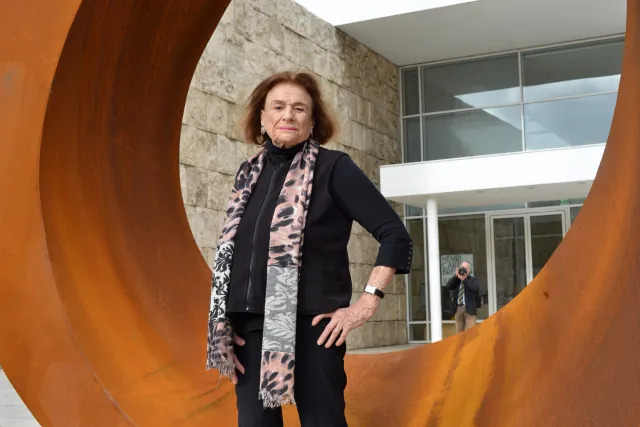
Beverly Pepper began her career as a painter, but turned to sculpture in 1960 after a trip to Angkor Wat, in Cambodia, where she was awed by the temple ruins surviving beneath the jungle growth. The artist made her debut in a Rome gallery with a show of carved tree trunks in 1962. When she was invited to make metal pieces for a festival in Spoleto, Pepper quickly convinced a local ironmaker to teach her how to weld. Sculpting in metal meant working in factories, a situation that the artist described as a Catch-22: A woman could not act like “a lady,” Pepper explained, or she would not be credible as a welder. Pepper even used the men’s room, since there were no ladies’ rooms in factories at that time. By the mid-1960s, she had mastered metalwork, constructing strings of boxlike shapes made from polished stainless steel. Later, Pepper made a series of earthbound sculptures by wedging triangular ridges in the landscape. She went on to combine abstraction and primitive forms to create what she called “totemic” pieces and “urban altars.” Even though Pepper did not like to draft models for her work, the General Services Administration’s Art-in-Architecture Program required artists to submit a maquette for design approval.
Track Beverly Pepper
Get notifications when works come to auction, and access market analytics
Create Free AccountAlready have an account? Sign In
Professional documentation gives you clarity, portability, and confidence in your collection.
Learn why collectors document their holdings online


Your collection, accessible anywhere
Access your collection from any device with our cloud-based platform. Native mobile apps provide seamless synchronization and offline browsing, ensuring your collection data is always at hand.


Biography
Beverly Pepper began her career as a painter, but turned to sculpture in 1960 after a trip to Angkor Wat, in Cambodia, where she was awed by the temple ruins surviving beneath the jungle growth. The artist made her debut in a Rome gallery with a show of carved tree trunks in 1962. When she was invited to make metal pieces for a festival in Spoleto, Pepper quickly convinced a local ironmaker to teach her how to weld. Sculpting in metal meant working in factories, a situation that the artist described as a Catch-22: A woman could not act like “a lady,” Pepper explained, or she would not be credible as a welder. Pepper even used the men’s room, since there were no ladies’ rooms in factories at that time. By the mid-1960s, she had mastered metalwork, constructing strings of boxlike shapes made from polished stainless steel. Later, Pepper made a series of earthbound sculptures by wedging triangular ridges in the landscape. She went on to combine abstraction and primitive forms to create what she called “totemic” pieces and “urban altars.” Even though Pepper did not like to draft models for her work, the General Services Administration’s Art-in-Architecture Program required artists to submit a maquette for design approval.
Track Beverly Pepper
Get notifications when works come to auction, and access market analytics
Create Free AccountAlready have an account? Sign In
Professional documentation gives you clarity, portability, and confidence in your collection.
Learn why collectors document their holdings onlineYour collection, accessible anywhere
Access your collection from any device with our cloud-based platform. Native mobile apps provide seamless synchronization and offline browsing, ensuring your collection data is always at hand.