Biography
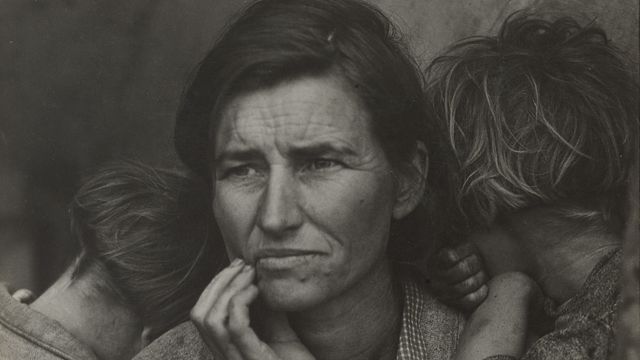
Dorothea Lange was a seminal American documentary photographer. Best known for her Depression-era pictures, she compassionately captured the squalid conditions of the people most effected by poverty and displacement. Born on May 26, 1895 in Hoboken, NJ, Lange survived polio during childhood that left her with a permanent limp in her right leg, an event which she cited as shaping her worldview and career. She went on to study photography at Columbia University in New York, eventually settling in San Francisco. Lange was hired by the Farm Security Administration to document the effects of the Depression on sharecroppers and other farm workers, and her indelible images—such as the instantly iconic Migrant Mother (1936)—shaped both public perception and government policy. Lange was also integral in helping Edward Steichen recruit photographers for his landmark exhibition “The Family of Man” at The Museum of Modern Art. Today, her works are held in the collections of the Art Institute of Chicago, the Getty Museum in Los Angeles, the Victoria & Albert Museum in London, and the Smithsonian American Art Museum in Washington, D.C., among others. Lange died on October 11, 1965 in San Francisco, CA.
Track Dorothea Lange
Get notifications when works come to auction, and access market analytics
Create Free AccountAlready have an account? Sign In
Professional documentation gives you clarity, portability, and confidence in your collection.
Learn why collectors document their holdings online


Your collection, accessible anywhere
Access your collection from any device with our cloud-based platform. Native mobile apps provide seamless synchronization and offline browsing, ensuring your collection data is always at hand.


Biography
Dorothea Lange was a seminal American documentary photographer. Best known for her Depression-era pictures, she compassionately captured the squalid conditions of the people most effected by poverty and displacement. Born on May 26, 1895 in Hoboken, NJ, Lange survived polio during childhood that left her with a permanent limp in her right leg, an event which she cited as shaping her worldview and career. She went on to study photography at Columbia University in New York, eventually settling in San Francisco. Lange was hired by the Farm Security Administration to document the effects of the Depression on sharecroppers and other farm workers, and her indelible images—such as the instantly iconic Migrant Mother (1936)—shaped both public perception and government policy. Lange was also integral in helping Edward Steichen recruit photographers for his landmark exhibition “The Family of Man” at The Museum of Modern Art. Today, her works are held in the collections of the Art Institute of Chicago, the Getty Museum in Los Angeles, the Victoria & Albert Museum in London, and the Smithsonian American Art Museum in Washington, D.C., among others. Lange died on October 11, 1965 in San Francisco, CA.
Track Dorothea Lange
Get notifications when works come to auction, and access market analytics
Create Free AccountAlready have an account? Sign In
Professional documentation gives you clarity, portability, and confidence in your collection.
Learn why collectors document their holdings onlineYour collection, accessible anywhere
Access your collection from any device with our cloud-based platform. Native mobile apps provide seamless synchronization and offline browsing, ensuring your collection data is always at hand.